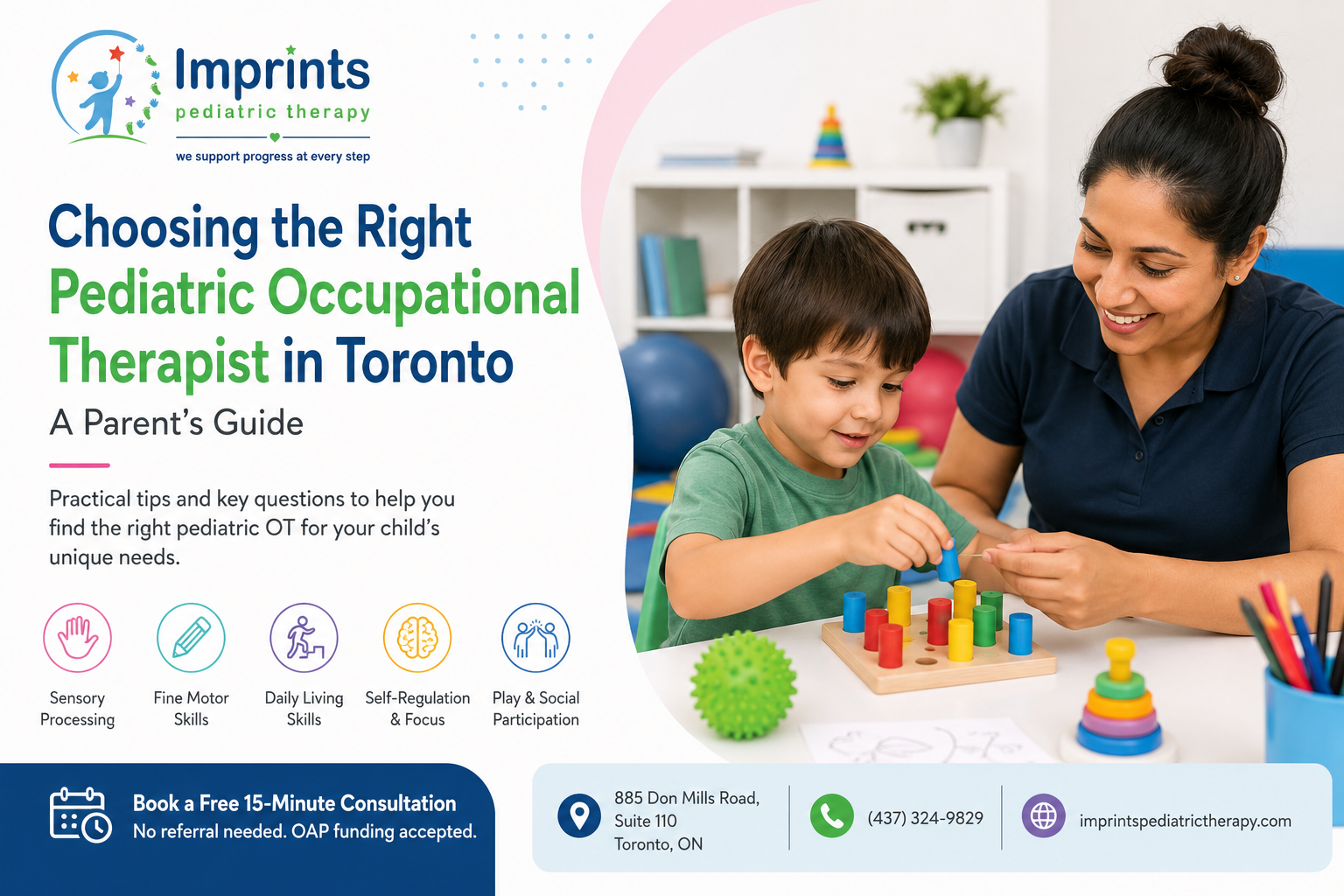
You’ve decided to look into occupational therapy for your child. Maybe a teacher had a problem. Your paediatrician may have mentioned it at the last checkup. Maybe you’ve been seeing things for a while now the meltdowns over getting dressed, how your child avoids anything messy, the pencil grip that doesn’t quite look right and you’ve finally decided to do something about it.
So what’s the next question most Toronto parents have? How do I actually find the right OT for my kid?
Toronto is not lacking in therapy clinics. If you google paediatric occupational therapy Toronto, you will be presented with dozens of options. They all have Web sites. They all claim to be play-based, family-centered. They all sound similar. So how do you cut through it and find the right fit for your child specifically?
This guide is written by Nalisha Noel, a registered occupational therapist and co-founder of Imprints Pediatric Therapy in Don Mills, Toronto. The goal is not to tell you to choose us it is to give you an honest, practical framework for evaluating any pediatric OT clinic in Toronto, so that whatever you decide, you feel confident it is the right choice for your family.
| What This Guide Covers What pediatric occupational therapy actually is and what it treats The difference between an OT and a pediatric OT and why it matters The questions you should ask before booking at any Toronto OT clinic What good pediatric OT sessions actually look and feel like Red flags to watch for when evaluating a clinic How to get started without needing a referral |
What is Pediatric Occupational Therapy?
Occupational therapy for children is often misunderstood. Many adults associate the word “occupational” with workplace rehabilitation, which is unrelated to what a pediatric OT does. For children, occupation refers to the everyday activities that are important to them. This includes playing, learning, eating, dressing, going to school, making friends, and being part of family life. When a child has difficulty with these activities, impacting their quality of life or their family’s, a pediatric occupational therapist can help. A pediatric OT is a registered health professional who identifies the reasons why a child struggles with certain activities. They then provide specific therapy to develop the necessary skills. The therapy is usually play-based because children learn best through play. Unlike older patients, children do not respond well to traditional adult-style teaching.
What Does Pediatric Occupational Therapy in Toronto Actually Treat?
Families in Toronto access pediatric occupational therapy for a wide range of reasons. The most common ones we see at Imprints include:
- Fine motor skill difficulties: Trouble holding a pencil, using scissors, doing up buttons, managing cutlery, or manipulating small objects
- Sensory processing differences: Over- or under-sensitivity to touch, sound, movement, taste, or other sensory input that affects daily routines
- Handwriting and school-related challenges: Poor pencil grip, letter formation problems, difficulty copying from the board, slow or illegible writing
- Self-care and daily living: Difficulty with dressing, feeding, toileting, or personal hygiene at an age when independence would be expected
- Emotional regulation and self-regulation: Frequent and intense meltdowns, difficulty managing transitions, impulsive behaviour, or shutting down emotionally
- Gross motor and coordination challenges: Tripping and falling frequently, poor balance, difficulty with sports or physical activities, body awareness issues
- Executive functioning: Planning, organising, starting and finishing tasks, managing time, and adapting to changes in routine
- School readiness: Preparing a child for the physical, attentional, and social demands of a classroom environment
- ADHD-related challenges: Building focus, impulse control strategies, organisation systems, and sensory regulation tools
- Autism spectrum support: Sensory integration, daily living skills, social participation, and building independence in structured and unstructured settings
Occupational Therapist vs Pediatric Occupational Therapist: Why the Distinction Matters
This is one of the most important things parents in Toronto miss when searching for occupational therapy for their child.
All occupational therapists in Ontario are registered with the College of Occupational Therapists of Ontario (COTO) and have completed a regulated degree program. But OT is a broad field. An occupational therapist who works primarily with adults recovering from strokes, workplace injuries, or hand surgery has a completely different day-to-day practice than one who works with children.
Pediatric occupational therapy requires specific knowledge of child development, play-based therapy approaches, sensory integration theory, neurodevelopmental conditions like autism and ADHD, and how to build rapport with children who may be anxious, sensory-sensitive, or non-verbal. These are not skills that come automatically from an OT degree they are built through pediatric-specific training and clinical experience.
When you are looking for an occupational therapist in Toronto for your child, always ask specifically about their pediatric experience not just their general OT experience. The two are not the same thing.
| At Imprints Pediatric Therapy, we work exclusively with children. Nalisha Noel holds a Master of Science in Occupational Therapy from Western University with a focus on pediatric practice. Every session at our Don Mills clinic is designed specifically for children the space, the tools, the approach, and the language we use. |
How to Choose the Right Pediatric OT in Toronto: 8 Questions to Ask
Before you book at any pediatric occupational therapy clinic in Toronto, these are the questions worth asking either during an initial call or by looking at the clinic’s website and credentials carefully.
1. Is the Occupational Therapist Registered with COTO?
In Ontario, occupational therapists must be registered with the College of Occupational Therapists of Ontario to practice legally. You can verify registration on the COTO public register at coto.org. This is a non-negotiable starting point and a good clinic will make their registration easy to find.
2. What Is Their Specific Experience With Children?
Ask how long they have been working specifically with children, what age ranges they see most often, and what conditions they have the most experience treating. A confident answer here is reassuring. Vague answers or a pivot to general OT experience are a sign to dig further.
3. What Does a Typical Session Look Like for a Child My Child’s Age?
The best pediatric OT sessions for young children look like play with a purpose. If the therapist describes a very structured, desk-based, instruction-heavy approach for a four-year-old, that is worth questioning. For toddlers and preschoolers especially, sessions should be child-led, movement-based, and designed around activities the child finds naturally engaging.
4. How Are Parents Involved in Sessions and at Home?
The most effective pediatric occupational therapy happens when parents understand the strategies the therapist is using and carry them into daily life. Ask whether parents are in the room during sessions, whether they receive home strategies after each visit, and how often the therapist checks in with parents on progress. A clinic that keeps parents at arm’s length is missing one of the most powerful drivers of child outcomes.
5. How Do They Measure Progress?
Therapy without clear goals and regular progress review is not therapy it is activity. Ask how goals are set after the assessment, how often they are reviewed, and what happens when a child is not progressing toward a goal as expected. A good pediatric OT has a clear answer to all of these.
6. Do They Accept OAP Funding or Extended Health Benefits?
Pediatric occupational therapy in Toronto is not covered by OHIP. However, many employer health benefit plans include OT coverage. Families with a child who has an autism diagnosis may be eligible to use Ontario Autism Program (OAP) funding for occupational therapy. Ask upfront whether the clinic accepts OAP and whether they can provide receipts in the format your insurer requires.
7. What Is the Wait Time for an Assessment?
In Toronto, wait times for pediatric OT can vary enormously from a few weeks at a private clinic to many months or more than a year through public school or publicly funded services. If you are pursuing private occupational therapy in Toronto, ask specifically how soon an initial assessment can be scheduled, and whether there is a waitlist for ongoing therapy after the assessment.
8. Do You Need a Referral?
In Ontario, you do not need a doctor’s referral to access private occupational therapy for your child. A good private clinic will tell you this clearly and make it easy to get started. If you are being told you need a referral before you can even have an initial conversation, that is an administrative barrier that most private Toronto OT clinics do not require.
What Red Flags Should Parents Watch For?
Most occupational therapy clinics in Toronto are run by genuine, caring professionals. But it is still worth knowing what a less-than-ideal situation looks like so you can identify it quickly.
Sessions That Feel Like Adult-Style Appointments
If your child is sitting at a table doing worksheets or being corrected on specific movements in a drill-based way especially if they are under seven that is not how evidence-based pediatric OT works for most children. Young children learn through play and movement. If sessions feel clinical and joyless to your child, outcomes will suffer.
No Parent Involvement or Communication
If you are consistently being asked to wait in the waiting room with no update, no home strategy handout, and no check-in on your child’s progress, something is wrong. The parent is the most important person in a child’s therapy journey. A therapist who sidelines parents is missing the most critical lever for progress.
Vague or Shifting Goals
After an assessment, you should receive a clear written report with specific, measurable goals for your child. If goals are vague (‘improve fine motor skills’), never updated, or difficult to understand in plain language, ask for clarification. Goals should be specific enough that you can see when your child has reached them.
Pressure to Book Long Blocks of Sessions Upfront
Some clinics ask families to commit to and pay for 10, 15, or 20 sessions before therapy even begins. While there is nothing inherently wrong with packages, be cautious about any situation where you feel pressured to commit to a large financial outlay before you have had a chance to see how your child responds to the therapist. One assessment and one or two sessions is a reasonable trial before a larger commitment.
What to Look for: A Quick Comparison
Here is a straightforward comparison of what to expect from a strong pediatric OT practice versus common shortfalls to watch for when evaluating clinics in Toronto:
| What to Look For | Strong Clinic | Watch For |
| Therapist is registered with COTO verifiable on coto.org | Yes | Not clear |
| Pediatric-specific experience clearly stated | Yes | Vague |
| Play-based, child-led sessions for young children | Yes | Desk-based |
| Parents involved in sessions and receive home strategies | Yes | Waitroom only |
| Written assessment report with specific goals | Yes | Verbal only |
| Progress reviewed regularly and plan adjusted as needed | Yes | No reviews |
| No referral required to book | Yes | Referral req. |
| OAP funding accepted | Yes | No |
| Clear, transparent fee structure provided upfront | Yes | Unclear |
| Consistent therapist for your child (not rotating staff) | Yes | Rotating |
What the Assessment Process Looks Like at a Good Toronto OT Clinic
Whatever clinic you choose in Toronto, the process for starting pediatric occupational therapy should follow a clear sequence. Here is what to expect and what Imprints Pediatric Therapy does specifically at each stage.
The Initial Conversation
Before an assessment is booked, a reputable pediatric OT clinic will have a conversation with you by phone or in person to understand what you are noticing with your child. This is not a sales call. It is a clinical conversation to make sure an OT assessment is actually the right starting point, or whether a different pathway makes more sense. At Imprints, we offer a free 15-minute consultation call for exactly this purpose.
The OT Assessment
The assessment is the foundation of everything that follows. A thorough pediatric OT assessment in Toronto covers your child’s fine and gross motor skills, sensory processing, daily living skills, executive functioning, and play. It includes both structured, standardised testing and free play observation because how a child performs on a formal task and how they play independently both tell you important things.
A parent interview is an equally important part of the assessment. How your child functions at home, in the morning routine, at mealtimes, and at bedtime is clinical information. The therapist is not just observing your child they are building a picture of your child’s life, not just their performance in a clinical room.
At Imprints, assessments typically run 60 to 90 minutes. Your child will not feel tested. The room is set up with a range of engaging materials, and the therapist spends the first part of the session simply building connection with your child before any formal observation begins.
The Written Report
After the assessment, you receive a written report. This document should be readable by a parent not just by another therapist or a school. It should clearly explain what was found, what it means for your child’s daily life, and what is recommended. It should include specific goals, not vague categories. And you should have the chance to ask questions and get plain-language answers before the report is finalised.
Ongoing Therapy Sessions
Sessions are typically 45 to 60 minutes. You should expect to know what happened in each session, what skill was targeted, and what you can do at home to support the work done in the clinic. Progress should be reviewed formally every few weeks not just at the end of a long block. And the plan should be adjusted when something is not working, rather than just continuing the same activities in the hope things will eventually shift.
Why Families Choose Imprints Pediatric Therapy in Toronto
We want to be direct here rather than promotional. There are good occupational therapists in Toronto, and we are not the only option. What we can tell you honestly is what makes families stay with us and refer others to us.
- Graduate-level training with a pediatric focus.
Nalisha holds a Master of Science in Occupational Therapy from Western University. Her training and clinical experience have been entirely in pediatric practice children’s development, sensory processing, neurodevelopmental conditions, and play-based therapy approaches. She did not come from an adult rehabilitation background and retrain. Pediatric OT is her area of expertise.
- We work exclusively with children.
Our clinic does not see adult patients. Everything in the space the layout, the materials, the language we use, the way sessions are structured is designed for children. Parents tell us their children actually want to come to sessions. That is not a coincidence.
- OT and speech therapy under one roof.
Many children benefit from both occupational therapy and speech therapy. At Imprints, Nalisha and Audrina Latchman (our registered speech-language pathologist) work alongside each other and collaborate directly on children who access both services. If your child needs OT now but speech concerns emerge later or vice versa you do not need to find a separate clinic and start the relationship-building process again.
- We accept OAP funding.
For families with a child who has an autism diagnosis and qualifies for the Ontario Autism Program, we accept OAP funding directly. This makes ongoing occupational therapy significantly more accessible for many Toronto-area families who would otherwise face substantial out-of-pocket costs.
- We are a small clinic, not a chain.
Your child will see the same therapist every session. That consistency matters in a way that is hard to overstate building trust with a child takes time, and that trust is what makes the therapy work. At a small clinic like ours, you can also actually reach us when you have a question or a concern. You will not be waiting on hold or navigating an automated system.
- We are honest when we are not the right fit.
If you contact us and a different service or provider would be a better match for your child, we will tell you. We would rather a child get the right support than fill a spot on our schedule with a family whose needs would be better served elsewhere.
Frequently Asked Questions About Pediatric Occupational Therapy in Toronto
| Q: How do I know if my child needs occupational therapy or speech therapy or both? |
| Many children benefit from both, and the concerns often overlap. A child with sensory sensitivities may also have difficulty with social communication. A child with attention difficulties may also have fine motor challenges that affect their ability to keep up in school. During our free initial consultation call, we can help you figure out the right starting point whether that is OT, speech, or an assessment for both. |
| Q: Does my child need a diagnosis to start occupational therapy in Toronto? |
| No. Many children who benefit from pediatric OT do not have a formal diagnosis. A diagnosis can be useful for accessing funding or school accommodations, but it is not required to start private occupational therapy. You can book an assessment at Imprints and begin therapy based on your child’s functional needs, regardless of whether a diagnosis is in place. |
| Q: What is the difference between private OT and OT through the school board or publicly funded services? |
| Publicly funded OT through school boards or services like CanChild typically involves longer wait times, less frequent sessions, and a focus on school-specific functional goals. Private pediatric occupational therapy in Toronto offers faster access, more frequent and individualised sessions, and a broader scope that covers home life and daily living as well as school. Many families use both public services for school-based goals and private OT for the fuller picture. |
| Q: How long does pediatric OT take? |
| Every child is different. Some children achieve their goals in 10 to 15 sessions. Others with more complex profiles benefit from longer-term support over a year or more. After the assessment, Nalisha will give you a realistic picture of what to expect for your child specifically, along with clear goals so you can see progress rather than just feeling like therapy is ongoing indefinitely. |
| Q: My child has ADHD. Can occupational therapy help? |
| Yes occupational therapy is one of the most effective non-medication supports for children with ADHD. A pediatric OT working with a child who has ADHD focuses on self-regulation strategies, sensory tools that support attention, executive functioning skills like planning and organisation, and practical techniques for managing transitions and daily routines. We see children with ADHD regularly at our Toronto clinic. |
| Q: My child has an autism diagnosis. Does Imprints work with autistic children? |
| Yes. We support children on the autism spectrum across a wide range of goals sensory integration, fine motor development, daily living independence, executive functioning, and social participation. We also accept OAP (Ontario Autism Program) funding, which can significantly offset the cost of ongoing therapy for families whose children qualify. |
| Q: Where is Imprints Pediatric Therapy located, and do you serve areas outside Don Mills? |
| Our clinic is located at 885 Don Mills Road, Suite 110 in Don Mills, Toronto. We regularly see families from North York, Scarborough, Flemingdon Park, Thorncliffe Park, Lawrence Park, Leaside, East York, and across the Greater Toronto Area. For many families, our Don Mills location is more accessible than a downtown Toronto clinic, with easier parking and a central position within the east Toronto corridor. |
Taking the Next Step
You started by searching for a pediatric occupational therapist in Toronto. That search brought you here. We hope this guide has given you a clearer picture of what to look for, what questions to ask, and what good pediatric OT actually looks like in practice.
If you would like to learn more about what we do at Imprints, or if you want to talk through whether an OT assessment makes sense for your child, the next step is a free 15-minute phone consultation. No commitment, no obligation just a real conversation with a registered OT who works with children like yours every single day.
| Book a Free 15-Minute Consultation Imprints Pediatric Therapy Pediatric OT & Speech Therapy in Toronto |