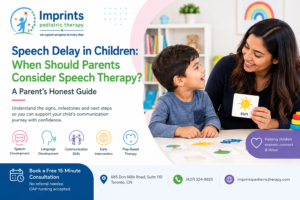
Your child is two years old and still not saying many words. Or maybe they are four and the other kids in JK can understand each other, but yours gets frustrated because nobody quite catches what they are trying to say. You have been carrying that quiet worry for weeks maybe longer.
If you live near Don Mills, North York, or the surrounding areas of east Toronto, finding the right speech therapy support for your child close to home makes an enormous difference. Consistency matters in early speech therapy. A clinic that is far away, hard to park at, or difficult to get to on a Tuesday afternoon will mean missed sessions, and missed sessions slow progress.
At Imprints Pediatric Therapy, we offer speech therapy for children right here in Don Mills, Toronto. Our speech-language pathologist works with toddlers, preschoolers, and school-age children to build the communication skills they need to connect with the people around them at home, in the classroom, and out in the world.
This guide is written to give you honest, practical information about speech therapy in Don Mills what it involves, how to know if your child needs it, what the process looks like, and how to take the next step without feeling overwhelmed.
| What This Guide Covers What speech therapy for children actually involves The most common speech and language challenges we see in Don Mills and North York Speech milestones by age and when to seek support What to expect from a first assessment at our Don Mills clinic Answers to questions parents ask us most often |
What is Speech Therapy for Children?
Speech therapy for children also called speech-language therapy is a specialised form of support provided by a registered speech-language pathologist (SLP). It focuses on how children communicate: how clearly they speak, how well they understand what is said to them, how they express themselves, and how they connect with others through language and conversation.
Speech therapy is not tutoring. It is not drilling your child with word lists or correcting every mispronunciation at the dinner table. It is a structured, play-based process guided by a registered professional who understands how language develops in children and what happens when that development needs a little extra support.
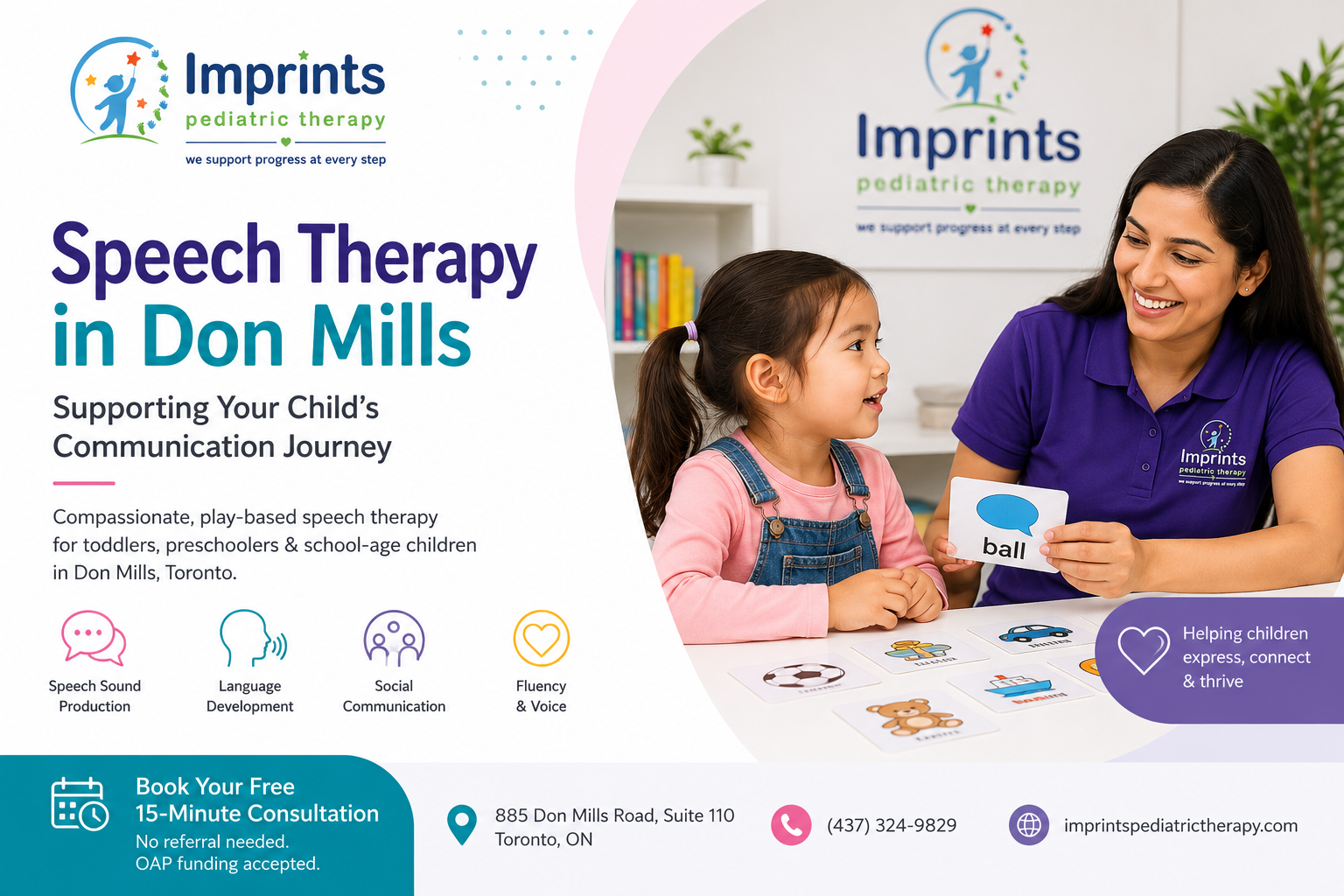
At Imprints Pediatric Therapy in Don Mills, every speech therapy session is designed to feel natural to the child. For toddlers, sessions look like play. For school-age children, they might involve games, reading activities, or conversation-based exercises. The goal is always the same: build real communication skills that transfer into the child’s actual daily life.
What Areas Does Pediatric Speech Therapy Cover?
Speech therapy for children covers much more than just pronunciation. When families in Don Mills and North York come to us for a speech therapy assessment, we look at the full picture of how a child communicates:
- Expressive language: The words a child uses and how they put sentences together to share ideas, ask questions, and tell stories
- Receptive language: How well a child understands what is said to them following instructions, answering questions, grasping concepts
- Speech sound production: How clearly a child produces individual sounds and words what is often called articulation
- Fluency: The smoothness of speech, including stuttering and cluttering
- Social communication: How a child uses language in conversation taking turns, staying on topic, reading facial expressions, understanding humour and social cues
- Voice: The quality, pitch, and resonance of a child’s voice, when these differ significantly from what is expected
Speech and Language Milestones: What to Watch For
One of the most common questions parents ask us at our Don Mills speech therapy clinic is: how do I know if my child is behind? The honest answer is that every child develops at their own pace, and there is natural variation within what is considered typical. But there are general milestones that speech-language pathologists use as a guide.
If your child is not meeting these milestones or if something just feels off even when they are technically within range trust your instinct and book an assessment. Early intervention in speech and language therapy consistently produces better outcomes than waiting.
| Age | Typical Speech & Language Development |
| 12 months | Says 1 to 3 meaningful words. Babbles using different consonants. Waves bye-bye. Responds to their own name. Points to get attention. |
| 18 months | Uses 10 to 20 words. Points to show interest in things. Follows simple one-step instructions. Imitates new words when they hear them. |
| 2 years | Uses 50 or more words. Starts combining two words together ‘more juice,’ ‘daddy go,’ ‘big dog.’ Strangers can understand about half of what they say. |
| 2.5 years | Uses two- and three-word phrases regularly. Vocabulary is growing quickly. Refers to themselves by name. Strangers understand about 75% of speech. |
| 3 years | Talks in short sentences. Asks simple questions. Uses pronouns like I, me, and you. Strangers understand about 75–80% of what they say. |
| 4 years | Tells short stories about things that happened. Sentences are mostly grammatically correct. Understood by unfamiliar adults almost all of the time. |
| 5 years | Uses complex sentences. Tells detailed stories. Asks ‘why’ and ‘how’ questions. Speech is clear and fluent in most situations. |
| A note on bilingual and multilingual children If your child is growing up with more than one language at home which is very common across Don Mills, North York, and the broader Toronto area it is important to assess their communication across both languages before drawing conclusions about a delay. A child who is bilingual may have a smaller vocabulary in each individual language but a combined vocabulary that is completely typical for their age. Our speech-language pathologist at Imprints is experienced working with multilingual families and will factor this into the assessment. |
Signs Your Child May Need Speech Therapy in Don Mills
These are the most common reasons families across Don Mills, North York, Flemingdon Park, and Thorncliffe Park come to our clinic for a speech therapy assessment. You do not need all of these to be present even one or two that are persistent and affecting your child’s daily life is reason enough to reach out.
Speech Delay
Your child is not meeting the milestones above by a margin that concerns you or their pediatrician. They have fewer words than expected for their age, are not combining words when other children their age are, or their vocabulary seems to have plateaued rather than growing steadily. Speech delay therapy starts with understanding why the delay is happening and the reasons vary greatly from child to child.
Articulation Difficulties
Your child talks a lot but is hard to understand. You know what they are saying because you are with them all day, but grandparents, daycare workers, or other children struggle to follow them. Articulation therapy in our Don Mills clinic focuses on the specific sounds your child is finding difficult, using techniques that make practice feel like play rather than work.
Language Development Concerns
Your child uses words but has difficulty putting them together into sentences, describing things, understanding stories, or following multi-step instructions. Language development therapy supports both the expressive side how they put words together, and the receptive side how well they understand what is being said to them.
Difficulty Being Understood Outside the Home
It is completely normal for parents to understand their child better than anyone else especially at 18 months or two years old. But by age three, most strangers should be able to understand a child about 75% of the time. If your child is consistently not understood by people outside the immediate family at an age when they should be, that is a useful signal to act on.
Frustration When Communicating
When children cannot communicate what they need or feel, frustration builds up. This can look like tantrums, withdrawal, avoiding social situations, or giving up on trying to talk altogether. Early intervention speech therapy in Don Mills can significantly reduce this frustration by giving children the tools to express themselves more effectively.
Social Communication Challenges
Your child has words and sentences but finds it difficult to use them in conversation taking turns, staying on a topic, understanding jokes or sarcasm, reading the room. Social communication therapy is especially relevant for children with autism spectrum disorder, but it is also appropriate for children without a diagnosis who simply find the social side of communication harder than their peers.
Stuttering or Disfluency
Some degree of disfluency repeating words, stretching sounds, pausing is completely normal between ages two and five as children’s language develops faster than their ability to produce it smoothly. But if stuttering is persisting past age five, if your child seems distressed by it, or if it is increasing rather than decreasing, a speech therapy assessment is the right next step.
Why Early Intervention in Speech Therapy Matters
We want to address the most common thing parents tell us when they finally call: ‘I wish I had come sooner.’
The early years of a child’s life particularly from birth to age five are when the brain is most receptive to language learning. The neural pathways that support communication are forming at a rapid rate during this period, and targeted speech therapy input during this window produces faster, more lasting results than the same intervention delivered at age seven or eight.
This does not mean that speech therapy after age five is ineffective it absolutely is effective, and we work with school-age children regularly. But the compounding effect of early intervention on a child’s confidence, school readiness, and social development is well-documented and significant.
Early intervention speech therapy in Don Mills and North York is something we feel strongly about at Imprints. If you are reading this and wondering whether it is too soon to reach out it is not. An assessment will give you information. Information is always more useful than waiting.
| You do not need a referral Families in Don Mills, North York, Scarborough, and across the GTA can book a speech therapy assessment at Imprints Pediatric Therapy directly no doctor’s referral required. You contact us, we have a brief conversation about your child, and we book the assessment from there. |
Speech Therapy in Don Mills: What the Process Looks Like at Imprints
One of the things parents tell us they value most is knowing what to expect before they walk in the door. Here is exactly how the process works at our Don Mills speech therapy clinic.
Step 1: The Initial Conversation
You contact us by phone or through the website. We have a brief, informal conversation about what you are noticing with your child. We ask a few questions. Based on that conversation, we will tell you honestly whether a speech therapy assessment is the right starting point, or whether a different direction might make more sense. There is no charge for this call.
Step 2: The Speech Therapy Assessment
The assessment is where we get a clear picture of your child’s communication profile. For most children, this is a single session of about 60 to 90 minutes. Our speech-language pathologist will assess receptive language, expressive language, speech sound production, and where relevant social communication and fluency.
The assessment is structured to feel like play, particularly for younger children. Your child will not feel like they are being tested. You will be in the room or observing throughout, and we will check in with you during the session to gather your perspective on how your child communicates at home which is just as important as what we observe in the clinic.
Step 3: The Report and Recommendations
After the assessment, you receive a written report. It outlines what we found, what it means, and what we recommend. We walk you through the report in plain language no clinical jargon without explanation. You ask questions. We answer them honestly. Then you decide how you want to proceed, without any pressure.
Step 4: Speech Therapy Sessions
If therapy is recommended, sessions are typically 45 to 60 minutes. For toddlers and younger children, a parent or caregiver is actively involved throughout the session. This is intentional the strategies your child’s SLP uses in the session are most effective when you understand them and can carry them into daily life at home, at mealtimes, during bath time, and in the car.
Progress is reviewed regularly. Every few weeks we check in formally on how your child is moving toward their goals and adjust the plan if needed. Not every child progresses in a straight line, and we do not expect them to.
Serving Don Mills, North York, and Surrounding Toronto Communities
Imprints Pediatric Therapy is located at 885 Don Mills Road, Suite 110 right in the heart of Don Mills, Toronto. We see children and families from across a wide area including North York, Flemingdon Park, Thorncliffe Park, Lawrence Park, Leaside, Scarborough, and East York.
For many of our families, having speech therapy in Don Mills rather than having to travel to a clinic in downtown Toronto makes a real practical difference. Therapy works best when it is consistent. A location that works within your family’s routine means your child actually gets to their sessions every week and that regularity is what drives progress.
We also understand that many families in Don Mills and North York come from a wide range of cultural and linguistic backgrounds. We approach every child’s communication development in the context of their family’s language environment, and we welcome families who are raising bilingual or multilingual children.
About Our Speech-Language Pathologist
Audrina Latchman is a registered speech-language pathologist with the College of Audiologists and Speech-Language Pathologists of Ontario (CASLPO). She has specialized training in PROMPT therapy a hands-on approach to treating motor speech disorders in children and works with children from toddler age through to school age on a full range of speech and language goals.
Audrina’s approach is parent-centred, culturally responsive, and grounded in play. She believes that the most effective speech therapy happens when children feel safe, engaged, and genuinely connected to the person working with them and when parents leave each session with something concrete they can do at home.
At Imprints, Audrina works closely alongside Nalisha Noel, our occupational therapist, to support children who benefit from both OT therapy. For children who need both services, this integrated approach under one roof means the two therapists can collaborate directly on your child’s plan rather than working in isolation.
Frequently Asked Questions About Speech Therapy in Don Mills
| Q: Do I need a doctor’s referral to access speech therapy in Don Mills? |
| No. In Ontario, families can access private speech therapy directly without a physician referral. You can contact Imprints Pediatric Therapy and book a speech therapy assessment for your child without any prior paperwork or a referral letter. |
| Q: How do I know if my child has a speech delay or a language delay and does it matter? |
| Speech delay refers to difficulty producing sounds and words clearly. Language delay refers to difficulty understanding or expressing language the vocabulary, grammar, and meaning behind words. Many children have both, and some have one without the other. The distinction matters because the therapy approach is different for each. A proper assessment at our Don Mills speech therapy clinic will identify exactly what is going on and tailor the approach accordingly. |
| Q: What age do you see children for speech therapy? |
| We work with children from about 18 months of age right through to school age and beyond. Some of our youngest clients are toddlers whose parents noticed something felt off before their child even turned two. If your child is very young and you have concerns, do not wait until they are older the earlier we can assess and support, the better the outcomes. |
| Q: Is speech therapy covered by OHIP in Ontario? |
| Private speech therapy at a clinic like Imprints is not covered by OHIP. However, many employer health benefits plans include speech-language pathology coverage. Families with a child who has an autism diagnosis may be eligible to use Ontario Autism Program (OAP) funding for speech therapy. We are happy to discuss funding options when you contact us. |
| Q: How many sessions will my child need? |
| Every child is different. Some children reach their therapy goals in 8 to 12 sessions. Others benefit from longer-term support, particularly when there are more complex language or social communication goals. After the initial assessment, our SLP will give you a realistic picture of what to expect for your child specifically not a generic answer. |
| Q: Can I be in the room during speech therapy sessions? |
| Yes and for young children especially, we actively encourage it. Parent involvement is built into how we run sessions at Imprints. When parents understand what the therapist is doing and why, they can carry the same strategies into daily life at home. That is where the real progress happens not just in the 45 minutes in the clinic. |
| Q: My child speaks two languages at home. Will that affect the assessment? |
| Bilingualism does not cause speech or language delays, and we do not treat it as a complicating factor. Our assessment approach considers your child’s communication across both languages and takes your family’s language environment fully into account. We work with multilingual families from across Don Mills, North York, and the wider Toronto area regularly. |
Ready to Take the Next Step for Your Child?
You do not need to have all the answers before you reach out. You do not need a diagnosis, a referral, or a long list of concerns written out. What you need is a five-minute phone call with someone who works with children like yours every single day.
At Imprints Pediatric Therapy in Don Mills, we offer a free 15-minute initial consultation. You tell us what you are noticing. We tell you honestly what the next step looks like. There is no pressure and no obligation just a real conversation with a registered speech-language pathologist who genuinely cares about getting your child the right support at the right time.
| Book a Free 15-Minute Consultation Imprints Pediatric Therapy Speech Therapy in Don Mills, Toronto |