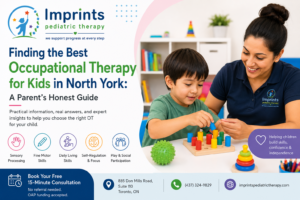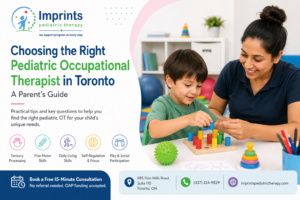
North York is a big place. If you live anywhere from Sheppard and Yonge down to Eglinton, or from the 401 across to Don Mills Road, and you are searching for occupational therapy for kids nearby you have probably noticed that the options can feel overwhelming and the information is not always easy to make sense of.
Some families find us through a friend. Some find us after a teacher flags a concern about their child’s pencil grip or difficulty sitting still. Some families have been sitting with a quiet worry for months, they have noticed their child struggles with things that seem to come easily to other kids, and they are finally ready to look into it.
Whatever brought you here, this guide is written to answer the questions parents in North York ask us most often: What is pediatric occupational therapy for kids? How do I know if my child needs it? And how do I find the right clinic for my child not just the closest one?
We are Imprints Pediatric Therapy, located at 885 Don Mills Road in Don Mills right on the edge of North York, easily accessible from Flemingdon Park, Lawrence Park, Leaside, Thorncliffe Park, and communities across the eastern part of North York. Nalisha Noel, our registered occupational therapist, works exclusively with children and has written this guide to give North York families an honest, practical foundation for making this decision.
| What This Guide Covers What pediatric occupational therapy is and what it addresses The most common signs North York children are referred for OT How to find and evaluate the right OT clinic near North York What the assessment and therapy process looks like from start to finish What makes Imprints different from other Toronto OT options Answers to the questions North York parents ask us most |
What is Pediatric Occupational Therapy and What Does It Actually Treat?
Occupational therapy for children is a specialised health service delivered by a registered occupational therapist (OT). Despite the name, it has nothing to do with work or employment. For children, “occupation” means the everyday activities that are meaningful and important to them playing, learning, going to school, getting dressed, making friends, eating, and participating in family life.
When a child struggles with these activities in a way that affects their daily functioning or their family’s a pediatric OT assesses what is driving those difficulties and provides targeted, play-based therapy to build the underlying skills the child needs.
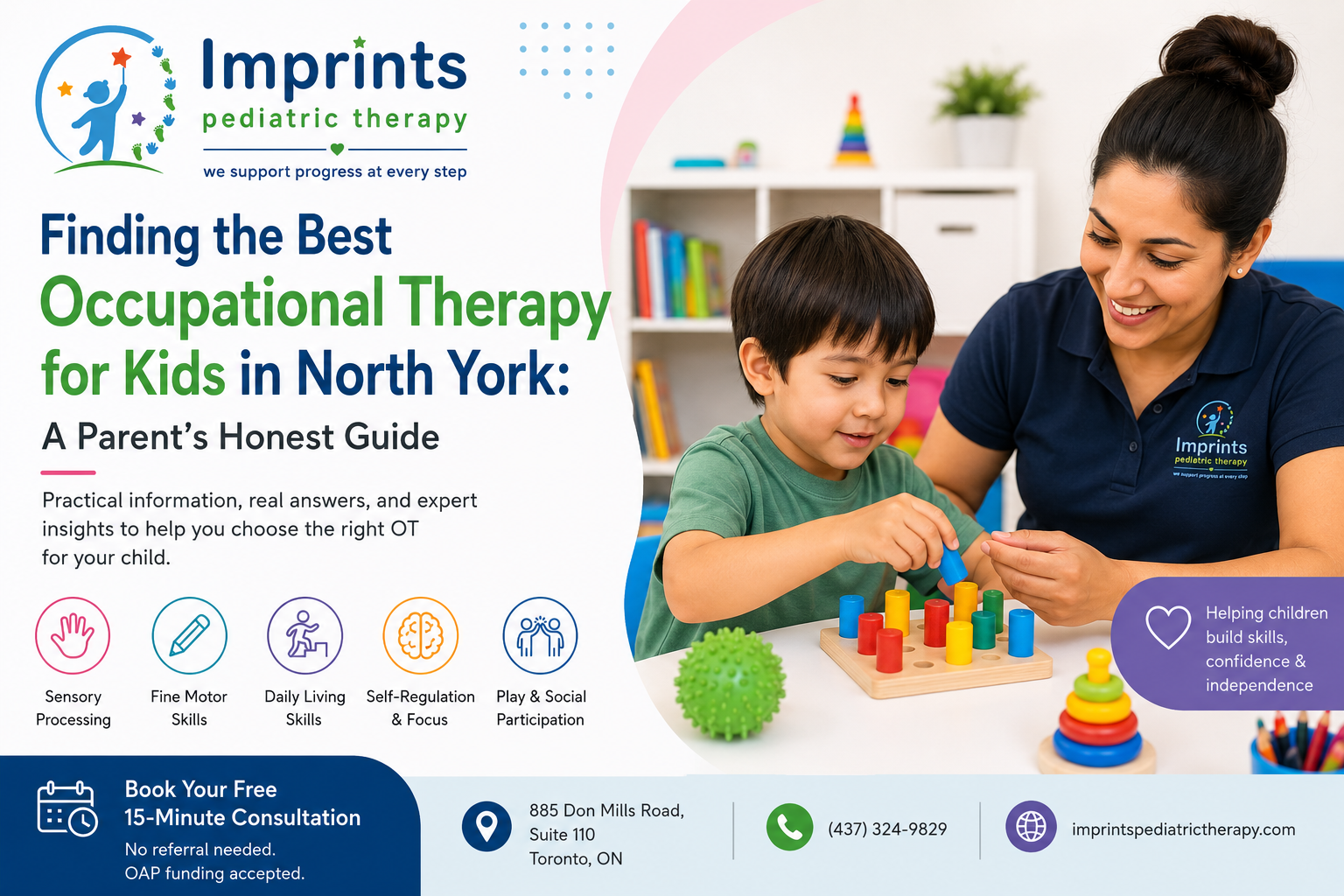
Families in North York come to us for pediatric occupational therapy for kids across a wide range of challenges. Below are the most common areas we work with:
| Area of Support | What It Covers |
| Fine Motor Skills | Pencil grip, writing, cutting with scissors, using cutlery, buttons, zippers, and small object manipulation |
| Sensory Processing | Over- or under-sensitivity to touch, sound, movement, taste, smell, or visual input that affects daily routines and behaviour |
| Handwriting | Letter formation, pencil pressure, spacing, speed, and legibility including school-based handwriting support |
| Self-Regulation | Managing emotions and behaviour, handling transitions, tolerating frustration, and calming strategies for daily life |
| Executive Functioning | Planning, starting tasks, organising belongings, managing time, and adapting to changes in routine |
| School Readiness | Preparing a child for the physical, attentional, and social demands of JK and SK |
| ADHD Support | Sensory tools for attention, impulse control strategies, organisation systems, and self-regulation support for children with ADHD |
| Autism Spectrum Support | Sensory integration, daily living independence, social participation, and functional skill-building for autistic children |
| Self-Care & Daily Living | Dressing, feeding, toileting, sleep routines, and personal hygiene at age-appropriate stages |
| Gross Motor & Coordination | Balance, body awareness, coordination, spatial orientation, and physical confidence in play and sport |
Signs Your Child May Need Occupational Therapy in North York
Most families do not come to us with a clear diagnosis and a list of goals ready to go. They come because something has been nagging at them something they notice at home, or something a teacher has mentioned, or a comparison to a sibling or a friend’s child that makes them wonder if their own child’s experience of the world is harder than it needs to be.
These are the signs we hear about most often from North York families who contact us for a pediatric OT assessment:
| What Parents Notice | What It Might Indicate for OT |
| Morning routines are a daily battle getting dressed, brushing teeth, eating breakfast | Sensory sensitivities, motor planning difficulties, or self-regulation challenges affecting transitions |
| Handwriting is messy, slow, or avoided even with practice | Fine motor skill delays, pencil grip difficulties, or poor core stability affecting seated writing tasks |
| Meltdowns are frequent and intense, especially during transitions or changes in routine | Self-regulation difficulties often linked to sensory processing differences or executive functioning challenges |
| Avoids messy play, certain textures, or foods or conversely seeks out intense physical sensations | Sensory processing differences either sensory sensitivity or sensory-seeking behaviour |
| Frequently falls, trips, bumps into things, or seems unaware of their body in space | Gross motor coordination or proprioceptive processing difficulties |
| JK or SK teacher has raised concerns about pencil grip, sitting posture, or keeping up with peers | Fine motor delays, sensory processing, or school readiness gaps that respond well to early OT intervention |
| Difficulty with self-care tasks like dressing, fastening buttons, or managing cutlery independently | Fine motor skill delays or motor planning difficulties affecting daily living independence |
| Child has received an autism or ADHD diagnosis and family wants functional, daily-life support | Pediatric OT is one of the most evidence-supported interventions for both autism and ADHD |
| You do not need a diagnosis to access pediatric OT Many children who benefit significantly from occupational therapy do not have a formal diagnosis. If you are noticing that daily life is harder for your child than it seems to be for other children their age in any of the areas above a pediatric OT assessment is a useful next step, regardless of whether a diagnosis is in place or being pursued. |
How to Find Occupational Therapy for Kids Near North York: What to Look For
North York families searching for pediatric occupational therapy for kids nearby have a number of options hospital-based OT, school-based OT through the Toronto District School Board, publicly funded services, and private clinics like Imprints. Understanding the differences helps families make a decision that fits their child’s timeline, goals, and circumstances.
Hospital-Based and Publicly Funded OT in North York
Publicly funded occupational therapy through the TDSB, Holland Bloorview Kids Rehabilitation Hospital, or other publicly funded programs can be excellent. The therapists are well-trained and the services are covered. The significant limitation is wait time. Depending on the program and your child’s referral priority, wait times for publicly funded pediatric OT in Toronto and North York can range from several months to over a year. For children who need support now, particularly those in the early years when the brain is most responsive to intervention, that wait often has a real cost.
School-Based OT in North York
The TDSB provides occupational therapy support for some children through in-school services. School-based OT typically focuses on school-specific goals pencil grip, classroom seating, handwriting, and school participation. It does not generally address the full range of what a child might need at home, during self-care, or in daily life outside the classroom. Many families access school-based OT for classroom goals and private OT for the broader picture of their child’s development.
Private Pediatric OT Clinics Serving North York
Private occupational therapy clinics in Toronto and the surrounding area offer faster access, more frequent and individualised sessions, and a broader scope that covers the child’s full daily environment home, school, and community. When evaluating any private OT clinic serving North York, here are the things that matter most:
- Verified COTO registration: All occupational therapists in Ontario must be registered with the College of Occupational Therapists of Ontario. Verify on coto.org before booking.
- Pediatric-specific expertise: OT is a broad field. Ask specifically about pediatric experience not just general OT credentials. A therapist who works primarily with adults is not the same as one trained in child development, sensory integration, and play-based therapy.
- Play-based approach for young children: For toddlers, preschoolers, and children in the early school years, effective OT sessions should look and feel like purposeful play not worksheets or drills.
- Clear parent involvement: Progress happens at home, not just in the clinic. A good OT clinic will include parents in sessions and send home strategies that transfer directly into daily life.
- Written assessment reports with measurable goals: After an assessment, you should receive a written report with specific, understandable goals. Vague goals that never change are not a good sign.
- OAP funding accepted: If your child has an autism diagnosis and qualifies for OAP, check whether the clinic accepts OAP funding this significantly reduces out-of-pocket costs for eligible families.
- Location and access: Consistency is critical in pediatric OT. A clinic that is realistic to get to every week is more valuable than a highly-rated clinic that is 45 minutes away.
Imprints Pediatric Therapy: Serving North York Families from Don Mills
Imprints Pediatric Therapy is located at 885 Don Mills Road, Suite 110 right at the eastern boundary of North York, where Don Mills meets Flemingdon Park and Lawrence Park to the north. For families across North York from Sheppard in the north to Eglinton in the south, and from Yonge Street east to the DVP our clinic is one of the most accessible private pediatric OT options in the area.
We know that for families in Flemingdon Park, Thorncliffe Park, Lawrence Heights, or the North York corridor along Don Mills Road, getting to a clinic in midtown or downtown Toronto adds real time and logistical difficulty to what is already a busy family week. Our location makes consistent attendance genuinely manageable for most North York families.
Why North York Families Choose Imprints
- We work exclusively with children.
Our clinic sees only pediatric clients. Every element of the space, the session structure, the materials, and the approach is designed for children from toddler age through to school age and beyond. This is not a general OT practice that sees children on the side.
- Nalisha Noel holds a Master of Science in Occupational Therapy from Western University.
Her training is in pediatric practice child development, sensory integration theory, neurodevelopmental conditions, and play-based therapy approaches. She has not come from adult rehabilitation. Pediatric OT is her specialisation and her daily practice.
- OT and speech therapy are available under one roof.
Many children who need occupational therapy also have speech and language goals. At Imprints, our occupational therapist and our registered speech-language pathologist, Audrina Latchman, work alongside each other and collaborate directly on children who access both services. For North York families whose child needs both which is common this integrated approach under one roof removes the need to manage two separate clinic relationships.
- We accept OAP funding.
Families with a child who has an autism diagnosis and qualifies for the Ontario Autism Program can use their OAP funding at our clinic for both occupational therapy and speech therapy. For eligible North York families, this significantly reduces the financial barrier to accessing regular, high-quality therapy.
- No referral is needed to book.
North York families can contact us directly and book an assessment without a doctor’s referral, a school board referral, or any prior paperwork. You contact us, we have a free 15-minute conversation about your child, and we book from there.
- You will always see the same therapist.
We are a small clinic, not a chain. Your child will have the same OT every session. Building trust with a child takes time and that trust is what makes the therapy actually work. Consistency of therapist is something we consider non-negotiable for quality pediatric OT.
What the Pediatric OT Process Looks Like at Imprints
Whether you are coming from North York, Don Mills, Flemingdon Park, or anywhere across the GTA, the process at Imprints follows a clear path. Here is what to expect at each stage.
The Free Initial Consultation
Before any assessment is booked, we offer a free 15-minute phone consultation. You tell us what you are noticing with your child. We ask a few questions and tell you honestly whether an OT assessment is the right starting point or whether a different pathway makes more sense. There is no charge for this call and no obligation to proceed.
The Pediatric OT Assessment
The assessment is the foundation of everything that follows. It is a single session of 60 to 90 minutes that covers your child’s fine and gross motor skills, sensory processing, self-care, executive functioning, and play. Our OT uses a combination of standardised assessment tools, structured observation, and free play because how a child performs on a formal task and how they play spontaneously tell you different, equally important things.
A thorough parent interview is part of every assessment. How your child wakes up in the morning, how mealtimes go, what bedtime looks like, and what the school day feels like for them this is all clinical information that shapes the assessment picture. You are the expert on your child’s daily life. A good assessment brings your observations together with the therapist’s clinical observations.
Your child will not feel like they are being tested. The clinic is set up with a range of engaging materials, and the first part of every session is simply about the therapist connecting with your child. For toddlers and younger children especially, the entire assessment is designed to feel like a play session.
The Written Report and Goal-Setting
After the assessment, you receive a written report. It covers what was found, what it means in practical terms, and what therapy is recommended. We walk you through the report together in plain language. You ask questions. We give you honest answers. Goals are specific and measurable not vague categories. You decide how to proceed, without any pressure.
Ongoing Therapy Sessions
Sessions are 45 to 60 minutes. For younger children, parents are in the room and actively involved throughout. After each session, you will know what was worked on and what you can do at home to support the skills being built in clinic. Home strategies are not optional extras they are an essential part of how pediatric OT actually works.
Progress is reviewed formally every few weeks. Goals are adjusted when a child has moved forward, or when a different approach would serve them better. We do not run sessions on autopilot. If something is not working, we say so and we change direction.
Early Intervention: Why Starting Sooner Matters for North York Children
The most consistent thing we hear from families who eventually come to us after waiting is: ‘I wish we had come sooner.’
The reason early intervention matters so much in pediatric OT is biological. The first five years of a child’s life are when the brain is most plastic most capable of forming new neural connections quickly and in response to targeted input. Occupational therapy delivered during this window produces faster, more durable results than the same intervention at age seven, eight, or nine.
This does not mean therapy after age five is ineffective it is, and we work with school-age children regularly. But the compounding effect of early OT on a child’s confidence, school readiness, peer relationships, and independence in daily life is significant and well-supported by the research.
If you are reading this as the parent of a toddler or preschooler in North York and something is nagging at you, do not wait for school to flag it. Book an assessment. If nothing significant is found, you will have peace of mind. If something is found, you will have given your child the most valuable thing you can: time.
| A note on the ‘wait and see’ approach We hear this often: ‘Our pediatrician said to wait and see.’ Sometimes this is appropriate advice. But waiting and seeing without any action is different from waiting with an OT assessment in hand. An assessment gives you specific information about your child. You can choose to monitor certain things, address others, and start therapy only where it is clearly warranted. Information is always more useful than an unanswered question. |
Frequently Asked Questions About Pediatric OT in North York
| Q: Is Imprints Pediatric Therapy in North York? |
| Our clinic is located at 885 Don Mills Road, Suite 110 in Don Mills, right at the boundary of North York. We are easily accessible from Flemingdon Park, Lawrence Park, Thorncliffe Park, Leaside, and communities across the eastern North York corridor. Many of our families live in North York and find our location significantly more convenient than clinics in downtown Toronto or Etobicoke. |
| Q: What is the difference between pediatric OT through the school board and private OT near North York? |
| School-based OT through the TDSB focuses on school-specific functional goals pencil grip, classroom seating, handwriting. Private pediatric OT at a clinic like Imprints covers the full scope of a child’s life: home routines, self-care, sensory regulation, play, family participation, and school. Access is also faster through private services assessments are typically available within a few weeks rather than several months or more. |
| Q: Does my child need a diagnosis before starting occupational therapy in North York? |
| No. Many children who receive and benefit from pediatric OT do not have a formal diagnosis. If your child is struggling with daily activities in a way that affects their quality of life or their development, an OT assessment is appropriate regardless of whether a diagnosis is in place. A diagnosis can be helpful for funding and school accommodations, but it is not a prerequisite for accessing private OT. |
| Q: My child is only two years old. Is it too soon for occupational therapy? |
| It is not too soon. We see children from approximately 18 months of age. The earlier we identify and address developmental challenges, the better the outcomes because the brain is most responsive to therapeutic input in the first years of life. If you have concerns about your toddler, a conversation with our team costs nothing and will give you honest guidance on whether an assessment makes sense at this stage. |
| Q: How often will my child need to come for OT sessions? |
| Most children start with weekly sessions, which gives enough frequency for skills to build progressively. Some children with more complex profiles benefit from twice-weekly sessions early on. As goals are reached, session frequency typically decreases. The specific recommendation for your child will come out of the assessment, not a generic schedule. |
| Q: Does private OT in North York cost a lot? Is any funding available? |
| Private occupational therapy at Imprints is not covered by OHIP. The cost varies by service our Plan and Fee page has current pricing. Many employer health benefit plans include OT coverage. Families with a child who has an autism diagnosis and qualifies for OAP (Ontario Autism Program) funding can use that funding at our clinic. We encourage all families to check their benefits coverage and contact us to discuss options before assuming the cost is prohibitive. |
| Q: What if my child needs both OT and speech therapy? |
| Many children benefit from both services. At Imprints, our occupational therapist Nalisha and our speech-language pathologist Audrina work together under one roof and collaborate directly on children accessing both services. You do not need to coordinate between two separate clinics or repeat your child’s history twice. We manage the clinical coordination, and parents simply come to one clinic. |
Ready to Find the Right OT for Your Child in North York?
Searching for pediatric occupational therapy in North York is the first step. The next one is simple: a free 15-minute phone call with our team. You tell us what you are noticing with your child. We tell you honestly whether a pediatric OT assessment makes sense and what the process would look like.
There is no referral needed. No commitment required from the call. Just a real conversation with a registered occupational therapist who works with children like yours every single week.
| Book a Free 15-Minute Consultation Imprints Pediatric Therapy Pediatric OT & Speech Therapy Serving North York, Don Mills, Flemingdon Park, Thorncliffe Park & the GTA 885 Don Mills Road, Suite 110, Toronto, ON (437) 324-9829 imprintspediatrictherapy.com No referral needed | OAP funding accepted | COTO registered therapist |